

The Daiwa BG Saltwater Spinning Reels combine a solid metal housing, smooth gearing, and a wide choice of sizes at a sensible price. This review covers the black-and-gold BG generation introduced in 2016, not the separate BG MQ series. The range runs from smaller freshwater reels to much larger saltwater models, but the right choice depends on line capacity, rod balance, and the fish you expect to catch.
Daiwa BG Technical Specifications Chart
| Specification | Details |
|---|---|
| Generation covered | Original black-and-gold BG range; separate from BG MQ and BG LT |
| Body | Black-anodized machined aluminum housing and side cover |
| Rotor | Graphite Air Rotor |
| Bearings | 6 ball bearings + 1 roller bearing |
| Models in the size chart | 1500–8000; ten US sizes |
| Gear ratios | 5.3:1–5.7:1 |
| Retrieve per crank | 28.3–53.3 inches |
| Weight | 8.5–30.0 oz |
| Drag | Carbon ATD; 4.4–33 lb maximum drag by size |
| Mono capacity example | 4000: 10 lb/300 yd or 12 lb/260 yd |
| J-Braid capacity example | 4000: 30 lb/280 yd or 40 lb/200 yd |
| Spool and handle | Aluminum ABS spool; screw-in handle |
| Water protection | Protected drag; the complete reel is not waterproof |
| Typical use | Freshwater to saltwater; match reel size to line, rod and target |
Feature Details: Latest Daiwa BG TECHNOLOGY Used in This Reel
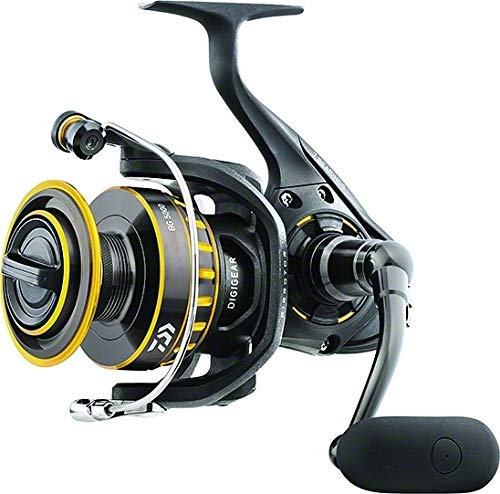
The Daiwa BG earns its appeal through straightforward construction: an aluminum body and side cover, an oversized main gear, and a screw-in handle. Its bearing arrangement is six ball bearings plus one roller bearing, not seven ball bearings. Let’s look at what those features mean on the water, along with the limits worth knowing before you choose a size.
 Click here to check today’s price
Black Anodized Machined Aluminum Housing (“Hard Bodyz” Body & Side Cover)
The machined aluminum body and side cover keep the gearing supported under load. Black anodizing forms a protective surface on the aluminum rather than adding a coat of paint. It improves corrosion and wear resistance, though scratches, salt deposits, and poor maintenance can still cause damage. The housing is metal; the Air Rotor is graphite.
 Check Today’s Price
OVER-SIZED DIGIGEAR™ (DIGIGEAR™ SYSTEM)
The oversized Digigear is one of the defining features of these Daiwa spinning reels. Its larger gear-tooth contact area helps distribute load during the retrieve. A rigid housing supports that gearing, but neither feature makes the reel immune to wear or replaces appropriate servicing.
Solid Screw-In Handle
The handle screws directly into the drive gear, giving it a firm connection during the retrieve. That is different from the knob’s attachment to the handle arm. Tighten the handle correctly and investigate looseness rather than assuming that every moving joint will remain free of play indefinitely.
AIR ROTOR
The graphite Air Rotor uses an open shape to distribute stress while reducing rotating weight. It helps the reel feel responsive without requiring an all-metal rotor. Body rigidity and rotor material are separate considerations when judging how a reel behaves under load.
ABS SPOOL
The aluminum ABS spool is designed to let line leave in larger coils, while its rubber center helps braided line grip the spool. Follow the recommended fill level for your line and reel; filling flush with the lip can cause loose loops and wind knots. Close the bail by hand and remove slack before retrieving to improve line lay.
Quick Overview at a Glance:
- Black Anodized Machined Aluminum Housing (“Hard Bodyz” Body & Side Cover)
- Over-sized Digigear (Digigear™ System)
- Solid Screw-In Handle
- Graphite Air Rotor
- Dynamic Cut Aluminum ABS Spool
- Braid-ready spool with rubber grip ring
- Protected carbon ATD drag; this does not seal the entire reel
- Manual Return Bail (4500 and Larger)
- 6BB+1RB
- Infinite Anti-Reverse System (4000 and Smaller)
- Infinite Dual Anti-Reverse System (4500 and Larger)
Daiwa BG Spinning Reels Model Specifications:
On small screens, scroll sideways to see every column.
|
Model Number:
|
Bearings: | Gear Ratio: | Line Per Handle Turn (in): | Weight oz: | Mono Capacity (lb/yd): | J-Braid Capacity (lb/yd): | Max Drag (lb): |
|---|---|---|---|---|---|---|---|
| 6+1 | 5.6:1 | 28.3″ | 8.5 | 4/155, 6/100 | 8/220, 10/130 | 4.4 | |
| 6+1 | 5.6:1 | 29.5″ | 8.5 | 6/135, 8/110 | 10/160, 15/130 | 4.4 | |
| 6+1 | 5.6:1 | 33.2″ | 9.3 | 6/210, 8/170 | 20/170, 30/120 | 13.2 | |
| 6+1 | 5.6:1 | 37.4″ | 10.8 | 8/240, 10/200 | 20/240, 30/190 | 15.4 | |
| 6+1 | 5.7:1 | 38.5″ | 14.1 | 10/240, 12/210 | 20/310, 30/230 | 17.6 | |
| 6+1 | 5.7:1 | 39.9″ | 14.3 | 10/300, 12/260 | 30/280, 40/200 | 17.6 | |
| 6+1 | 5.7:1 | 43.1″ | 22.0 | 14/350, 17/280 | 40/340, 50/270 | 22 | |
| 6+1 | 5.7:1 | 47.4″ | 22.6 | 14/470, 17/380 | 50/360, 65/310 | 22 | |
| 6+1 | 5.3:1 | 48.7″ | 29.5 | 20/370, 25/310 | 65/440, 80/330 | 33 | |
| 6+1 | 5.3:1 | 53.3″ | 30.0 | 20/550, 25/440 | 65/590, 80/440 | 33 |
Specifications above refer to the original US BG range. Capacity pairs mean line strength in pounds/yards. Actual capacity varies with line diameter and how tightly it is wound. Maximum drag is a limit, not a recommended fishing setting; use a setting suited to the rod, line, and knots.
Daiwa BG size guide: avoid buying more reel than you need
The 1500 and 2000 have a 4.4 lb maximum drag and suit lighter tackle. The 2500 and 3000 add capacity and drag while staying relatively manageable for repeated casting. Match the reel to the rod and technique; our bass spinning-reel guide explains the practical size choices.
The 3500 and 4000 step up in weight. The jump to the 4500 is larger: it weighs 22 oz versus 14.3 oz for the 4000. Sizes 4500 and above use a manual-return bail, so turn it closed by hand rather than expecting the handle to trip it.
The 5000, 6500, and 8000 offer more room for heavier line. The 6500 and 8000 have a slower 5.3:1 ratio but retrieve plenty of line because of their larger spools. See our BG5000, BG6500, and BG8000 comparison for that larger-size decision.
Is the Daiwa BG waterproof or suitable for offshore fishing?
Protection around the carbon ATD drag does not make the body watertight. The original BG is not Magsealed, and its drag protection should not be mistaken for a whole-reel IPX rating. Avoid intentional dunking, sand, and high-pressure washing. Gently clean the exterior after saltwater use, dry it, and arrange servicing if water gets inside.
Larger BG sizes can suit some boat, jigging, and offshore work. That does not make every size appropriate for tuna or sharks. Expected fish size, sustained drag, line reserve, and the complete rod-and-reel outfit matter more than the species name alone. For repeated heavy offshore use or regular wave exposure, compare purpose-built alternatives with the appropriate capacity and sealing.
Original Daiwa BG vs. BG MQ
The original BG uses a conventional aluminum body and side cover. BG MQ is a separate design with an aluminum Monocoque body and threaded engine plate, revised gearing, and a Long Cast ABS spool. Its size numbers, weights, and drag ratings should not be substituted into the table above. Our BG MQ review covers that different family.
Daiwa BG Spinning Reels Video:
Daiwa BG Spinning Reels Review: Owner Experiences
Owners highlight the BG’s smooth retrieve, firm handle connection, and value, while some report wobble or drag problems. Their purchase prices reflect what they paid at the time. Reports of surviving accidental immersion should not be treated as a feature of the reel.
Great for the price
Fantastic Reel
One owner felt the BG offered strong value and compared its performance favorably with their ShimanoStradic. That is a personal comparison rather than proof that the two reels perform identically.
 Check Review on Amazon
The appeal in this account is a solid, smooth reel without moving into premium-reel prices.
The only Reel I truly trust
Smooth in both inshore and offshore
Saltwater Compatible
Outstanding Reel
 Check Review on Amazon
The same account describes landing a 23.5-inch largemouth bass on a BG2000 with 6 lb line, with the drag absorbing several runs. It is an example of one catch rather than a size recommendation for every situation.


What size Daiwa BG spinning reel would you recommend for Red Snapper fishing in the Gulf in 200 feet of water off Florida? I go there a few times a year and go out on party charters and I’m fed up with their gear. I was thinking the 5000 but think the 6500 might be better but I also don’t want to over kill it and look foolish. Thanks Tracy
Buy This
Thanks, I plan on mounting it on a Ugly Stik Tiger Elite Spinning Fishing Rod. Thoughts?
That can be a sensible pairing, Tracy, but check the exact Tiger Elite spinning model rather than the name alone. For red snapper in 200 feet, the rod needs to suit the sinker weight your charter uses, your line and the drag you intend to fish. Strong current can make the sinker requirement the deciding factor. Before buying, ask the skipper what weights they normally use and check the rod’s ratings against that. A larger reel adds line reserve, but it cannot make an underpowered rod suitable.